
The FMCSA Clearinghouse Process from A to Z
May 31, 2026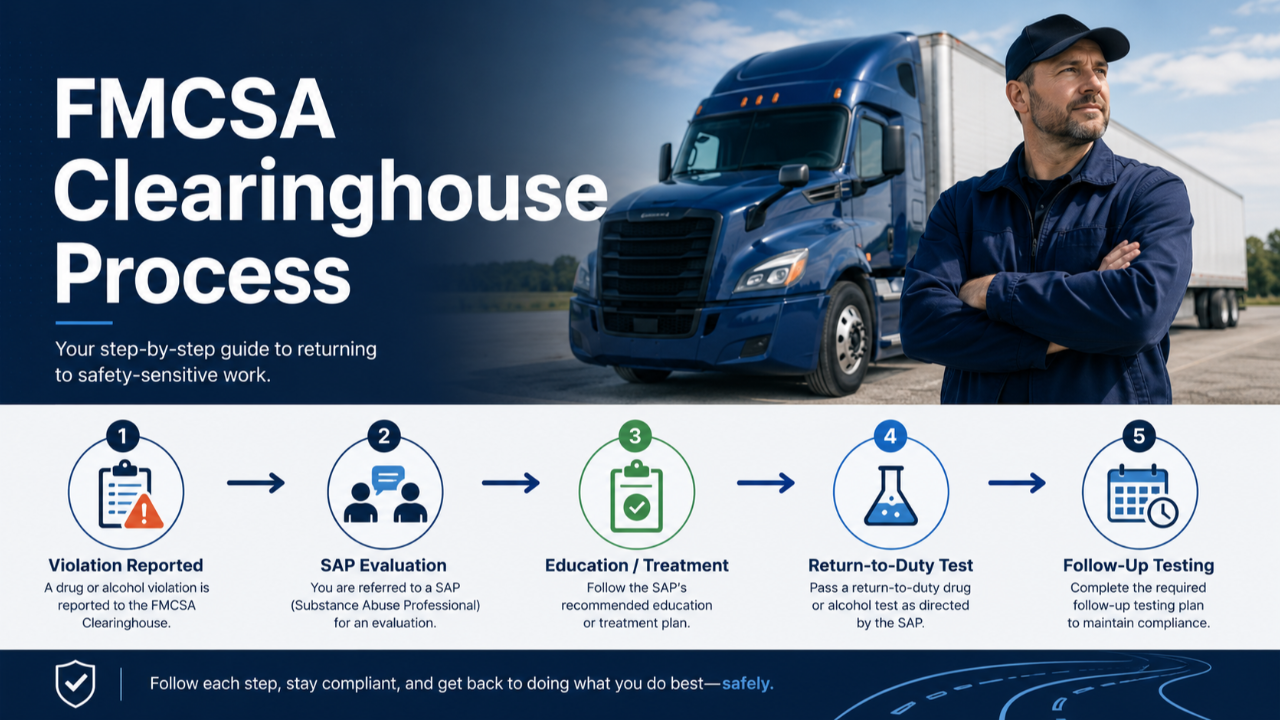
TANGLEWOOD BEHAVIORAL HEALTH GROUP
THE DOT CLEARINGHOUSE PROCESS
From Violation to Return to Duty
A step-by-step guide to every phase of the federal return-to-duty process
The FMCSA Drug and Alcohol Clearinghouse is a secure federal database that tracks DOT drug and alcohol violations for safety-sensitive employees. When a violation occurs, it is recorded in the Clearinghouse. As you complete each step of the return-to-duty process, that record is updated.
This document walks through all four phases of the Clearinghouse process from the moment a violation is confirmed to the completion of your follow-up testing period. Every step is explained in plain language.
|
PHASE 1 Violation & Reporting Steps 1–3 |
PHASE 2 SAP Evaluation & Requirements Steps 4–7 |
PHASE 3 Return to Duty Steps 8–10 |
PHASE 4 Follow-Up Testing Ongoing |
|
PHASE 1 1 |
Violation and Reporting What happens immediately after a positive test or a refusal to test. |
|
STEP 1 |
Positive Test Result or Refusal to Test The process begins when a DOT drug or alcohol test comes back positive, or when an employee refuses to take a required test. Under federal regulations, a refusal is treated exactly the same as a positive result. There is no distinction in the system. ● A positive drug test and a refusal to test both trigger the same process. ● The type of test that produced the violation does not change the steps that follow. ● This applies to all six testing categories: pre-employment, random, reasonable suspicion, post-accident, return-to-duty, and follow-up.
Important: If you refused a test rather than testing positive, you are in the same return-to-duty process and must complete the same steps. |
|
STEP 2 |
Employer Reports the Violation to the Clearinghouse As soon as a violation is confirmed, your employer is required by federal law to report it to the FMCSA Drug and Alcohol Clearinghouse. This report must be made within three business days. ● The Clearinghouse is a secure federal database maintained by the Federal Motor Carrier Safety Administration. ● The report is not optional. Your employer does not have discretion about whether to file it. ● Once your record is in the Clearinghouse, any current or prospective DOT employer who queries the system with your consent will see it. ● Your record will remain open in the Clearinghouse until you complete the full return-to-duty process.
Important: Your Clearinghouse record will be updated at each major milestone as you move through the process. Completing each step is what moves your status forward. |
|
STEP 3 |
Removal from Safety-Sensitive Duty Immediately following a confirmed violation, you cannot perform any safety-sensitive functions. This is not a disciplinary decision your employer is making on their own. It is a federal requirement. ● You cannot operate a commercial motor vehicle, aircraft, rail equipment, pipeline, or any other safety-sensitive function. ● This removal remains in effect until you complete the full return-to-duty process. ● This step applies regardless of industry, employer size, or the specific substance involved.
Important: This step is designed to protect you, your coworkers, and the public. It is not a judgment about who you are as a person. It is a procedural requirement that applies to every safety-sensitive professional in a DOT-regulated industry. |
|
PHASE 2 2 |
SAP Evaluation and Requirements Your active participation begins here. This phase involves working with a Substance Abuse Professional (SAP). |
|
STEP 4 |
Find a Qualified SAP Finding a qualified Substance Abuse Professional is your responsibility. Some employers provide a SAP referral through their Employee Assistance Program (EAP). If your employer offers this, it is a good place to start. You also have the right to choose your own SAP. ● A DOT-qualified SAP must hold a current license or certification as a physician, psychologist, social worker, employee assistance professional, or drug and alcohol counselor. ● They must have specific knowledge of substance use disorders and DOT regulations under 49 CFR Part 40. ● You can search for a SAP through your employer's EAP, your union, or professional directories. ● The DOT does not maintain an official approved list. Confirm credentials before you begin.
Important: Warning: Some individuals advertise faster return-to-duty timelines or guaranteed outcomes. A legitimate SAP cannot ethically rush a clinical evaluation or skip required steps. Working with an unqualified SAP can invalidate your entire process and require you to start over at your own expense. |
|
STEP 5 |
SAP Conducts Your Initial Evaluation Your first meeting with the SAP is a face-to-face clinical evaluation. The SAP will ask about your substance use history, your current situation, and other factors that help them understand where you are and what you need. ● This is a clinical interview, not an interrogation. It is designed to gather information so the SAP can make an appropriate recommendation. ● Based on this evaluation, the SAP will assign a course of education and/or treatment. ● The assignment is individualized. It is based on your specific situation, not a standard checklist. ● For some people, this means completing an education program like the one you are in now. For others, it may mean outpatient counseling, intensive outpatient treatment, or another level of care.
Important: Be honest during your evaluation. Your SAP's ability to make an accurate, appropriate recommendation depends on the information you provide. |
|
STEP 6 |
Complete Your SAP's Requirements This is where this education course fits in. If your SAP has assigned a substance use education program, you are completing that requirement right now. But education alone may not be all that is required. ● Your SAP's recommendations may include education, counseling, outpatient treatment, intensive outpatient care, or other components. ● You are responsible for completing all of the requirements, not just some of them. ● Keep documentation of everything you complete. Your SAP needs evidence of completion before scheduling your follow-up evaluation. ● Do not assume that finishing this course means you are done. Contact your SAP to confirm what they require.
Important: You cannot move to Step 7 until your SAP confirms that you have completed all assigned requirements. |
|
STEP 7 |
SAP Conducts Your Follow-Up Evaluation Once you have completed all assigned requirements, your SAP will schedule a follow-up evaluation. This is another face-to-face meeting. The SAP will review your completion documentation, assess your progress, and determine whether you are ready to return to safety-sensitive duties. ● If the SAP is satisfied with your progress, they will provide a recommendation for return to duty. ● If they are not satisfied, they may assign additional requirements before making that recommendation. ● Once cleared, your SAP notifies the Designated Employer Representative (DER) that you are authorized for the return-to-duty test. ● You cannot switch to a different SAP because you disagree with their recommendation. The SAP who conducted your initial evaluation is the one who conducts your follow-up.
Important: Completing the minimum requirements does not automatically guarantee a positive recommendation. Your engagement, honesty, and follow-through matter. |
|
PHASE 3 3 |
Return to Duty The final steps that officially clear you in the federal system. |
|
STEP 8 |
Return-to-Duty Drug Test (Directly Observed) Before you can go back to any safety-sensitive function, you must take a drug test and receive a verified negative result. This test is a directly observed collection. A trained collector will observe the collection process. ● The directly observed requirement is non-negotiable for return-to-duty testing. ● Your employer or C/TPA will order this test. You do not choose the collection site on your own. ● A positive result, a refusal, or a cancelled test does not satisfy the return-to-duty requirement. If that happens, you go back to your SAP. ● If you do not have an active employer, you will use a Consortium or Third-Party Administrator (C/TPA) to order and manage your test.
Important: Consider testing privately before your official return-to-duty test, especially if marijuana was involved. THC can remain in your system for weeks. A positive result on your official test creates a new violation and restarts the process. |
|
STEP 9 |
Negative Result Reported to the Clearinghouse After your test comes back negative, your employer or C/TPA reports that result to the FMCSA Clearinghouse. This is the update that changes your status in the federal system. ● Your Clearinghouse record, which showed an open violation since Step 2, now reflects that you have completed the return-to-duty process. ● Until this update is made, your status still shows an open violation. Any prospective employer querying the system will see that status. ● It is in your interest to make sure this step happens promptly after your negative result is confirmed. ● Follow up with your employer or C/TPA to confirm the Clearinghouse has been updated. |
|
STEP 10 |
Return to Safety-Sensitive Duty Once your employer queries the Clearinghouse and sees that your return-to-duty process is complete and your negative test result is recorded, they can authorize you to return to safety-sensitive functions. You are legally cleared to go back to work. ● Your employer must confirm the Clearinghouse update before authorizing your return. ● Returning to duty is not the end of this process. It is the beginning of Phase 4. ● Your follow-up testing plan is already in effect the moment you return to work.
Important: Returning to work is a real accomplishment. Protect it by understanding what comes next in Phase 4. |
|
PHASE 4 4 |
Follow-Up Testing Ongoing unannounced testing during your return to safety-sensitive duty. |
|
STEP 11 |
Your Follow-Up Testing Plan Begins When you return to safety-sensitive duties, you enter a follow-up testing period. Your SAP creates a follow-up testing plan that is specific to you. Federal law sets a minimum, but your SAP determines the full schedule. ● Federal regulations require a minimum of six unannounced tests in your first 12 months back on the job. ● Your SAP can assign more than six tests and can extend the testing period for up to 60 months (five years). ● The minimum is a floor, not a ceiling. Your actual plan depends on your SAP's clinical judgment. ● These tests are unannounced. You will not receive advance notice. ● You may be tested early in the morning, mid-shift, or on a day you do not expect. The only thing you control is being ready.
Important: Make sure your phone number and contact information are current with your employer and your C/TPA. A missed test because of an outdated phone number is still a missed test. |
|
If You Miss or Refuse a Follow-Up Test A refusal or missed follow-up test is reported to the Clearinghouse as a new violation. There are very few exceptions. Common situations that are not accepted as valid excuses: ● Being stuck in traffic or having a transportation issue ● A sick child or family emergency (in most cases) ● Getting the appointment time or location wrong ● Not receiving a notification due to outdated contact information A new violation means starting the entire return-to-duty process over: new SAP evaluation, new requirements, new return-to-duty test, and a new violation record in the Clearinghouse. |
|
Why Follow-Up Testing Exists Follow-up testing is not punishment. It is a structured monitoring system. Research on recovery from substance use disorders shows that sustained support and accountability improve long-term outcomes. People who complete follow-up programs have better recovery trajectories than those who navigate this period without structure. Every negative follow-up test is documentation. It is proof that you are doing what you said you would do. It protects your position. It protects your license. Each test you pass is part of the record that shows you are back on track. |
Quick Reference: All Steps at a Glance
|
Phase |
Step |
What Happens |
|
Phase 1 |
Step 1 |
Positive test or refusal confirmed |
|
Phase 1 |
Step 2 |
Employer reports to Clearinghouse within 3 business days |
|
Phase 1 |
Step 3 |
Removed from safety-sensitive duty |
|
Phase 2 |
Step 4 |
Find a qualified SAP |
|
Phase 2 |
Step 5 |
SAP conducts initial evaluation |
|
Phase 2 |
Step 6 |
Complete all SAP requirements |
|
Phase 2 |
Step 7 |
SAP conducts follow-up evaluation and clears you for RTD test |
|
Phase 3 |
Step 8 |
Return-to-duty drug test (directly observed) |
|
Phase 3 |
Step 9 |
Negative result reported to Clearinghouse |
|
Phase 3 |
Step 10 |
Authorized to return to safety-sensitive duty |
|
Phase 4 |
Step 11+ |
Minimum 6 unannounced follow-up tests in first 12 months; up to 5 years |
This document is part of the Tanglewood Behavioral Health Group DOT Substance Use Education Program. It is intended for participants in the DOT SAP return-to-duty process and may not be reproduced or distributed without written permission.
Tanglewood Behavioral Health Group | Houston, Texas | tanglewoodbehavioral.com
Browse our courses to understand every step of the return-to-duty process. We walk you through SAP evaluations, treatment, and Clearinghouse requirements so you know what to expect.
Stay connected with news and updates!
Join our mailing list to receive the latest news and updates from our team.
Don't worry, your information will not be shared.
We hate SPAM. We will never sell your information, for any reason.